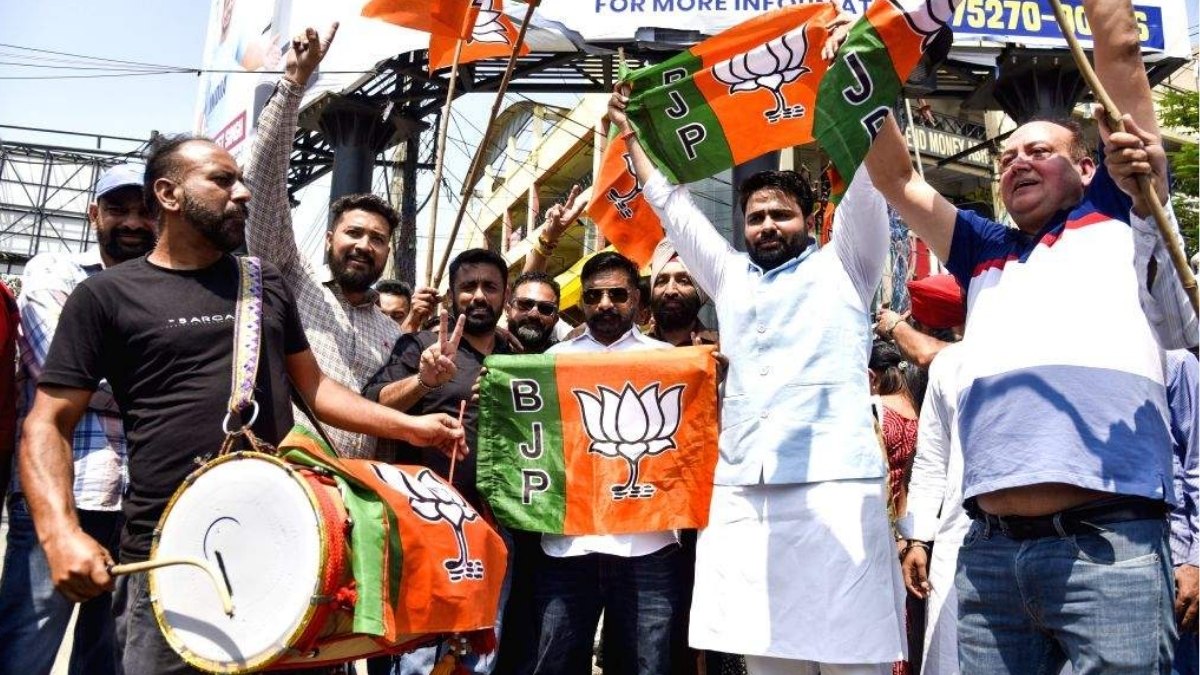



‘The People’s Mandate’: How PM Modi’s Personal Brand Rewrote Rules Of 2026 State Polls In Favour Of BJP, In a political landscape often shaped by regional equations and local leadership, the 2026 state elections marked a decisive shift. At the center of this transformation stood Narendra Modi, whose personal brand once again proved to be the Bharatiya Janata Party’s most potent electoral asset.
Across multiple states, the Bharatiya Janata Party (BJP) leveraged Modi’s image not merely as a campaign figurehead but as the defining narrative of its political outreach. What emerged was less a conventional state election and more a referendum-style contest framed around leadership, governance, and national vision.
Centralization of Campaign Strategy
Unlike previous elections where state leaders played a dominant role, the BJP’s 2026 campaign leaned heavily into centralized messaging. Rallies, advertisements, and digital outreach consistently foregrounded Modi’s persona—projecting continuity, stability, and decisive governance.
Political analysts note that this approach effectively blurred the line between national and state issues. Local concerns—from unemployment to infrastructure—were reframed within the broader context of national progress, often tied back to central government schemes and Modi’s leadership.

The Power of Personal Branding
Modi’s appeal continues to cut across traditional caste and regional divides, a factor that proved crucial in states with fragmented political landscapes. His image as a strong, incorruptible leader resonated with first-time voters and urban middle classes, while welfare schemes helped consolidate support among rural and economically weaker sections.
More Read

The BJP’s campaign machinery amplified this brand through targeted social media strategies, high-frequency rallies, and carefully curated messaging. The result was a highly personalized electoral battle, where voting for the BJP was implicitly framed as endorsing Modi himself.
Opposition Struggles to Counter Narrative
Opposition parties found it difficult to counter this personalized campaign. Attempts to localize elections around state-specific issues often struggled to gain traction against the BJP’s nationalized narrative.
Moreover, the lack of a unified opposition face further tilted the scales. While regional leaders retained influence in pockets, none matched the nationwide recognition and organizational backing associated with Modi.
More Read

Electoral Outcomes and Implications
The results reflected this strategic shift. The BJP either secured clear majorities or emerged as the single largest party in key states, outperforming expectations in regions traditionally considered competitive.

These outcomes suggest a redefinition of electoral dynamics in India. State elections, once dominated by local factors, are increasingly influenced by national leadership narratives—particularly when anchored by a figure with strong personal branding.
The Modi Factor as an Anti-Incumbency Shield – The Most striking Trend of Monday’s results is the BJP’s ability to retain power in Assam and Puducherry while making historic gains in West Bengal.

Breaking the Southern and Eastern Barriers
The 2026 outcomes signify the Prime Minister’s success in dissolving the linguistic and cultural barriers that once limited the BJP’s expansion. In Puducherry, the retention of power reinforces the party’s strategic foothold in the southern coastal belt, proving that the Prime Minister’s appeal can supersede traditional Dravidian or regional identities. Even in Kerala, where the LDF faced headwinds from a disillusioned youth, the Prime Minister’s frequent visits and focus on modern infrastructure provided a bridge for the BJP to make inroads into the “revolutionary red” legacy.
A New Formation or Roadmap for 2027 & 2029 Elections?
The 2026 state polls may well serve as a blueprint for future campaigns, not just for the BJP but for all political parties. The emphasis on centralized leadership, cohesive messaging, and brand-driven politics signals a broader transformation in how elections are fought and won in India.
However, questions remain about the long-term sustainability of this model. Can a national figure continue to overshadow local leadership indefinitely? Or will regional dynamics eventually reassert themselves?
For now, the verdict is clear: in 2026, the BJP didn’t just win elections—it redefined the rules of the game, with Narendra Modi’s personal brand at its core.
More Read

This Just Won’t Show The BJP’s Majority Win, But Also The Aura of PM Modi a Personal Brand. Also This Should Be Mentioned That PM Modi Is Connected To Roots of India and With Their Own BJP Karyakarta.